
The Herbalist's Apprentices Never Came Home
An old herbalist arrives at a mountain village to collect a new apprentice — only to find that all her former students have disappeared, and the villagers won't meet her eyes, only glance toward the trees.
Created: 5/2/2026 · 9 min read
Scene 1 — Setup
The village smelled of smoke and fear.
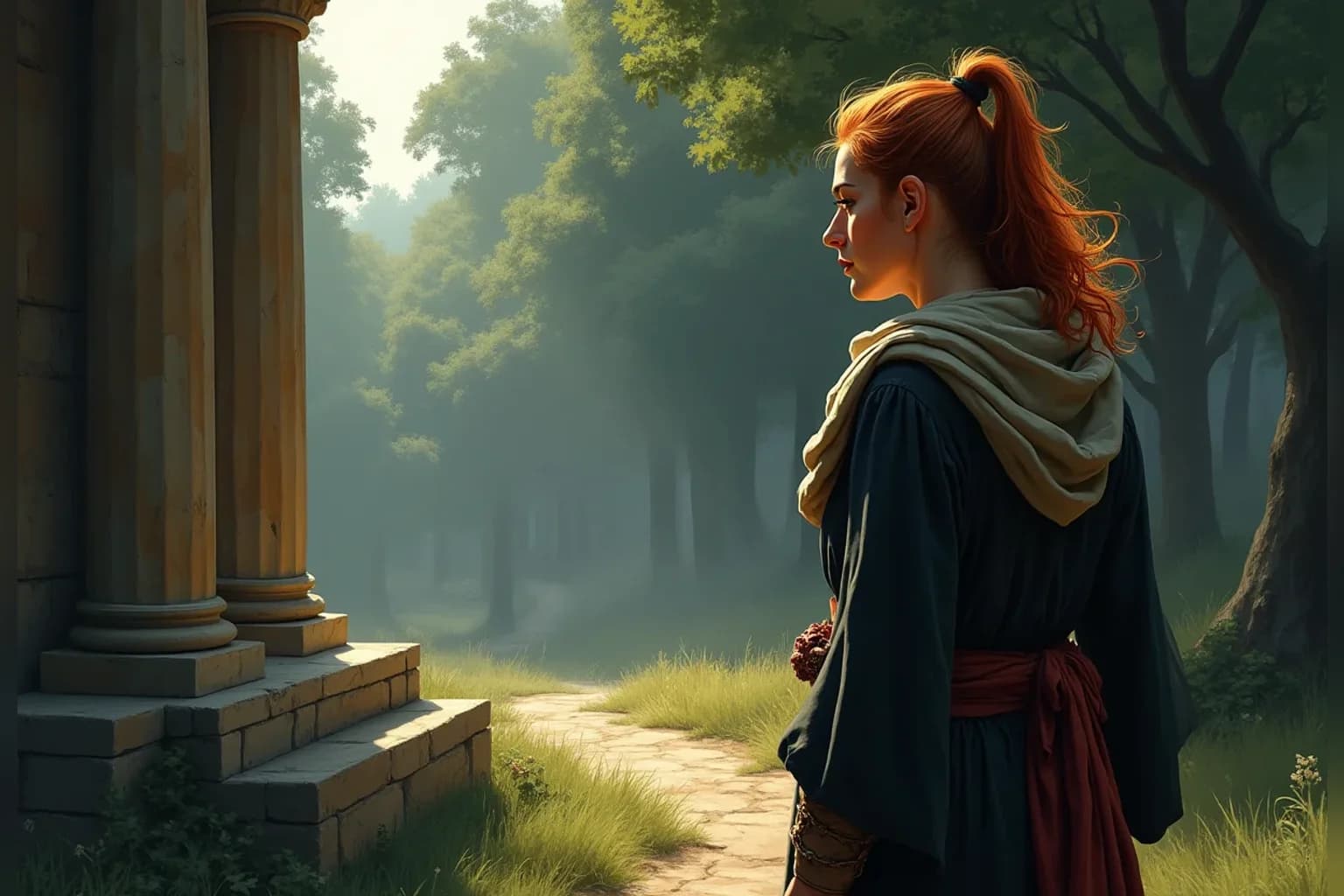
Araks came down from the pass at the hour when shadows stretched in long tongues across the road. Her hair — the color of autumn copper, caught at the shoulder — was pulled at by a dry wind. Three silver rings in her left ear chimed softly with each step, the only sound she allowed herself in unfamiliar places. Her shoulders were broad as a blacksmith's, her back straight, though she was nearly forty now and remembered the pass as easier than this.
She was looking for Mirra. Then Sayra. Then Felia. Three apprentices over three years, all from this village, all gone to learn and never returned — that much was ordinary. But not one had sent a sign. No leaf, no bird-bone, no knotted cord. Nothing.
The first person she passed — an old man with a goat — looked at her with dark eyes and turned down an alley. A woman at the well dropped her gaze before Araks could open her mouth. A boy playing by a gate grabbed a stone and closed his fist around it — not threatening, just holding on.
"Did Mirra Tessova live here?" Araks asked a man mending a fence.
He didn't look up.
"She did," he said at last, his voice flat as a stone under water. "Went into the forest. Like all the others."
His hand with the hammer went still. His eyes slid toward it — toward the dark wall of trees beyond the last houses — and quickly came back down.
Araks stood and looked at the forest. No wind came from it. No birds flew over it. And somewhere deep in her old, well-worn gut, something clenched and said quietly: *go back*.
But three apprentices were still in there, unanswered.
Scene 2 — Development
Mirra's house stood at the very edge of the village — low, with a sagging thatched roof and a door that was shut but not latched. Araks pushed it open with her shoulder.
Inside it smelled of an old hearth and something else — a faintly sweet, faintly unsettling smell she couldn't name at first. Resin. No — wax with bitter herb. The smell of ritual.
One room. A pallet with a blanket thrown aside, crumpled as though someone had risen in a hurry. Clay pots on a shelf — three of them overturned. On the table, a flatbread gone stone-hard with age and an oil dish knocked over, the oil long since soaked into the wood. The dark stain had spread into a shape Araks didn't like.
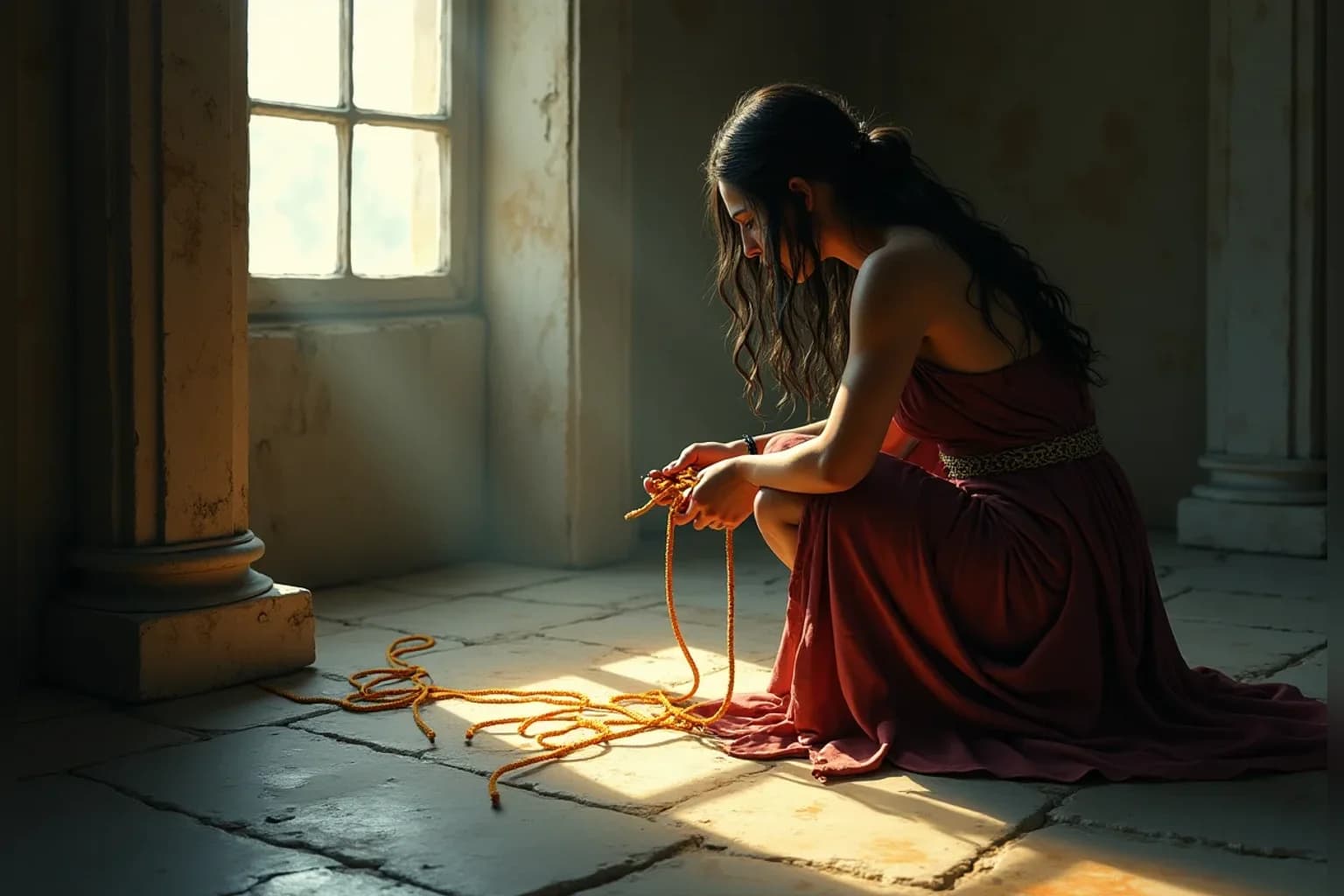
She crouched by the pallet and ran her hand under the straw mattress. Her fingers found a cord.
A knotted cord. Mirra had left a sign after all.
Araks held it up to the light from the small window. Eight knots — that was more than just *I'm all right*. She read them slowly with her fingers: *found. calls. can't. go.*
The last knot was tied twice and twisted — the way you tied when you were afraid. When there was no time to explain.
Araks crouched there, holding the cord in her broad palms, and felt something cold move down her spine. *Calls* — not *something*, but someone specific. Mirra had known where she was going. Mirra had gone toward the call.
Beyond the village wall, the forest stood without moving, without wind.
In the corner of the room Araks noticed one more thing: on the threshold — on the inside — someone had drawn a line in ochre. Not a protective sign. A warning.
The line had been drawn from outside.
Scene 3 — Climax
There were two village elders, and they weren't hard to find: they sat on a stone bench by the communal hearth as though they had no intention of going anywhere. The hearth had been cold a long time. The square around it was empty, only wind pushing dust between the paving stones. Two old men in linen cloaks bleached to the color of bone, watching Araks as though they had been expecting her.
That in itself was a bad sign.
"Mirra Tessova," she said, without greeting. She held the cord clenched in her fist; the rings in her ear were silent — she stood perfectly still. "Sayra. Felia. Three girls from your village. Where did they go?"
The elder — his face cut with wrinkles deeper than age alone could account for — looked at her fist.
"They were called," he said evenly. "We didn't stop them."
"Who called them?"
The second old man laced his hands on his knees and stared at the ground.
"The one who lives in the grove," said the first. "He comes every few years. He takes those who can hear. Your girls — they could hear."
Araks felt something seize in her chest and stop.
"And you let them go."
"We tried to hold back Mirra's mother when she wanted to follow." The old man's voice didn't waver. "She burned on the threshold. From the inside. Without fire."
Silence settled over the square like a stone dropped into water.
"The grove," Araks repeated. "Is there a path?"
The elder finally raised his eyes to her — dark, tired, without hope.
"There is," he said. "But those who went looking didn't come back." A pause. "Except one. He came back without memory and without a name. Lives with the blacksmith now. Makes sounds."
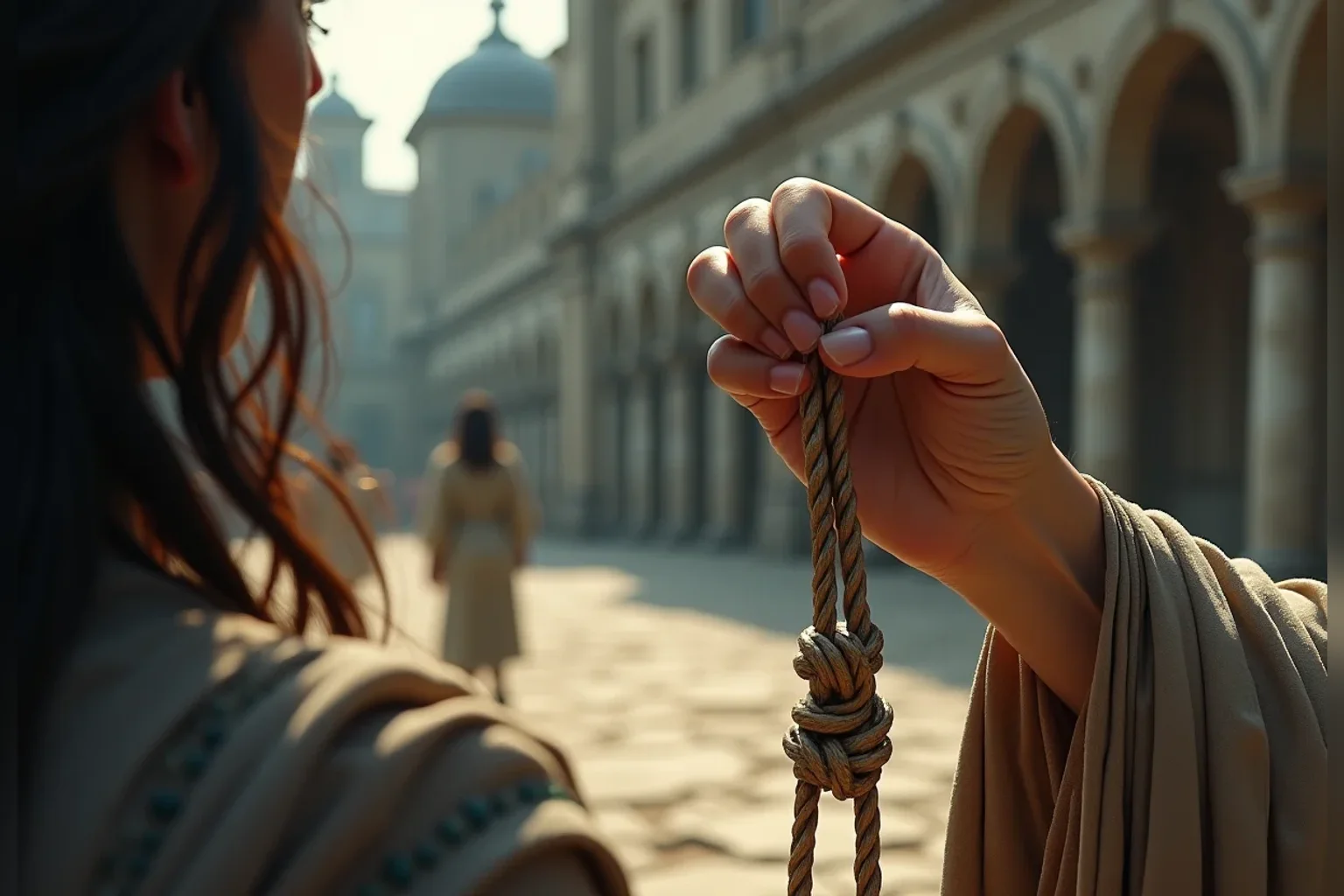
Araks opened her fist. The knotted cord lay across her palm, and the last knot — doubled, twisted — looked up at her like a closed eye.
Scene 4 — Development
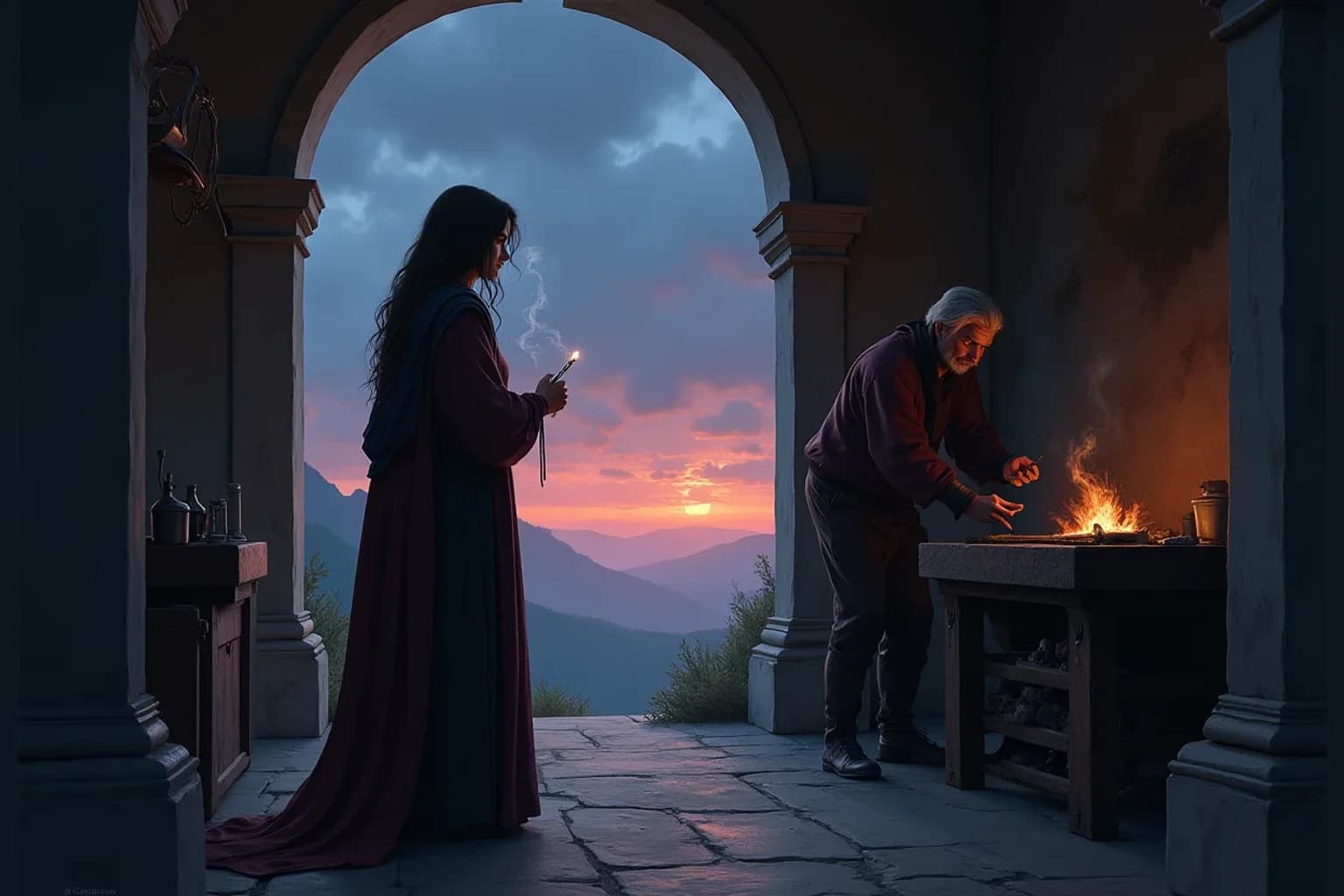
The smithy stood apart from the rest — where the village began to dissolve into wasteland. The heat from it reached her a dozen paces out, and Araks was almost glad of it: after the empty square and the dead hearth, warmth felt like something alive. A wide awning with rows of tool blanks hanging beneath it. Coals in the forge — red, breathing. An anvil worn with the memory of a thousand blows.
The blacksmith — young, with burn scars on his forearms — glanced back and didn't look surprised. People here seemed to have forgotten how to be surprised.
"The elders sent you," he said. Not a question.
"I need to see the one who came back from the grove."
The blacksmith nodded toward a lean-to. A low door, nearly flush with the ground. Araks ducked and went in.
He sat in the corner on a pile of straw — a man of about thirty, powerfully built once, by the look of him. Now dried out, like cured meat. His hands rested on his knees, palms up. Eyes open, gaze fixed on the wall, and through it, and beyond.
"Hey," said Araks quietly.
Nothing.
She crouched in front of him and looked into his eyes. The pupils — normal, alive. He breathed steadily. But when she laid the knotted cord across his palm, his fingers closed around it — slowly, like a sleeper's.
And he spoke.
Not in words. In sound — low, sustained, like the hum of a drawn string just before it snaps. But in that sound Araks caught something familiar. A rhythm. The same rhythm as the knots in the cord.
The cord in his fist darkened.
Araks pulled it away sharply and stood. Her heart beat steadily — she had long since trained it not to race with fear. But the fingers holding the cord felt warmth where there should have been none.
The blacksmith stood in the doorway watching her.
"Is he always like this?" she asked.
"Only when someone comes asking about the grove," the blacksmith answered. "Or when it gets dark."
Outside, the sky was already deepening to violet.
Scene 5 — Finale
The grove received her in silence.
Not the silence of mountain nights — alive, full of the earth's breathing. This forest was quiet like dead metal: no cricket, no rustle of leaf, no crack of branch underfoot. Araks walked a path that was barely visible — only pressed-down grass and the smell of the same bitter wax as in Mirra's house. The three silver rings in her ear made no sound. She noticed that.
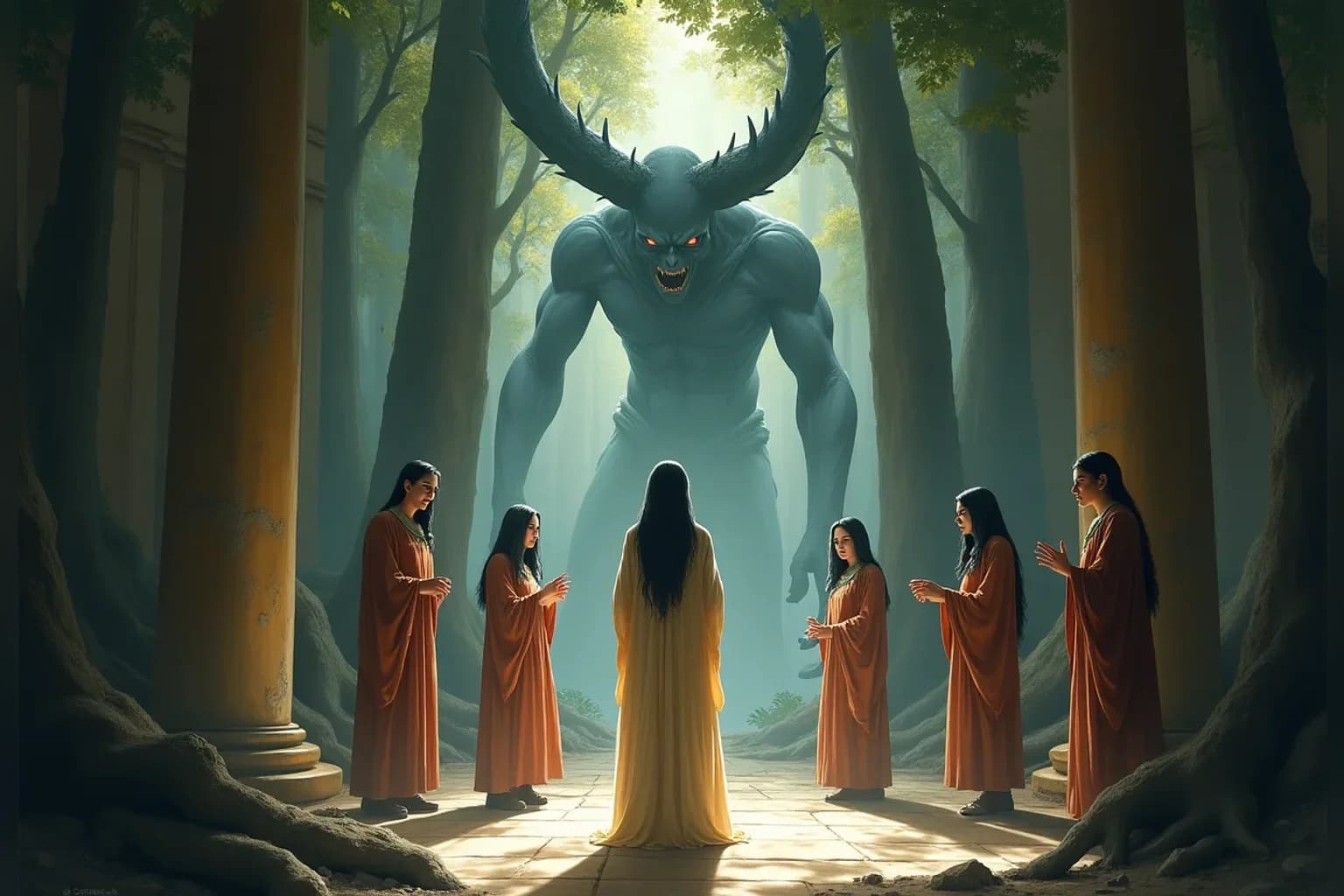
In the center of the grove stood an altar — a flat stone, darkened by sacrificial oils. Around it sat three figures. Not bound. Not asleep. Simply sitting, like the man in the smithy, palms up, eyes fixed on nothing.
Mirra. Sayra. Felia.
Alive. Empty.
Above the altar stood the one who had called them — the height of an ordinary man, but with a shadow that fell the wrong way. A face like any middle-aged man's, unremarkable in every detail. That, more than anything, was what made it terrible.
"You've come to take them back," he said. "The first in many years."
Araks took out the knotted cord and untied the last knot — the doubled, twisted one. Slowly, deliberately. Her fingers didn't shake.
"No," she said. "I've come to settle a debt."
She laid the cord on the altar. Eight knots — eight names of those she hadn't been able to save before. The rite of exchange, old as the earth itself: debt for debt, memory for memory. She knew its price.
The shadow beneath him shifted. Something in the grove moved — as though a vast mechanism had turned one tooth forward.
The three figures at the altar inhaled at the same moment.
Mirra raised her head. In her eyes — confusion, pain, life.
Araks stood and looked at her apprentices. Something in her chest clenched and then, slowly, with effort, let go. She didn't know exactly what she had left on that stone along with the cord. But as they walked back through the grove — all four of them, shoulder to shoulder — the birds above the trees finally cried out.