
The Voice in the Midnight Mechanism
A young watchmaker in a small provincial town is restoring an antique grandfather clock — and every night at midnight he hears a woman's voice coming from inside the mechanism. No one else can hear it.
Created: 5/2/2026 · 9 min read
Scene 1 — Setup
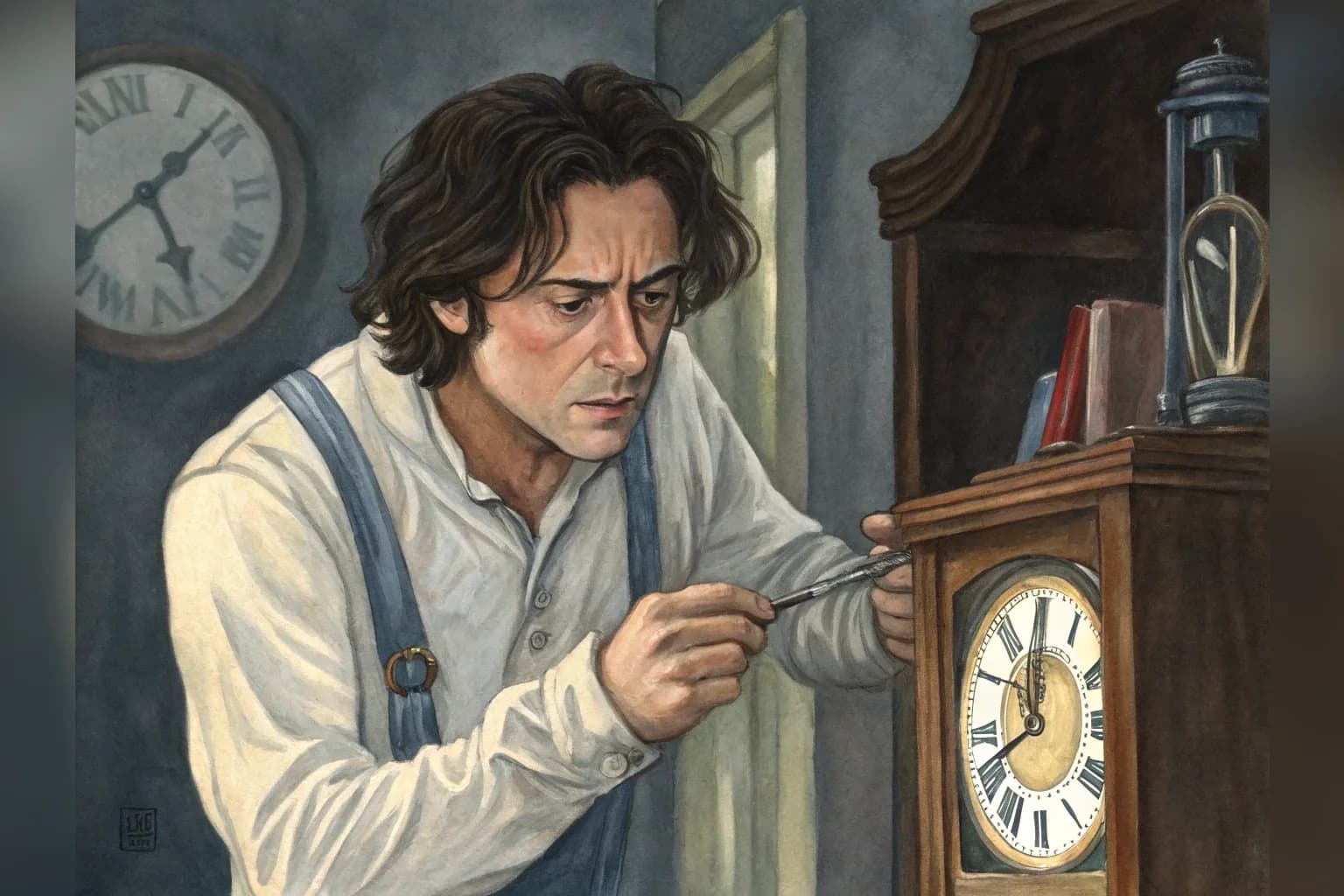
The hands on the clock face had frozen at 11:59, and Mark set down his tweezers.
He was in his early thirties, but his fingers already bore the permanent marks of the trade — ink ground into the skin from marking gears, dark crescents under his nails. Dark-brown eyes squinted behind a loupe: the clock's spring mechanism clearly resented being tampered with. His shoulder-length hair kept falling across his forehead, and he pushed it back with the back of his hand, careful not to smear grease on the glass.
The clock had been standing in the corner of his workshop for three weeks now. A massive oak case, darkened with age, with brass scrollwork on the cabinet doors. Its owner — an elderly woman named Nina Sergeyevna from Lesnaya Street — swore it had stopped running on the exact day her mother died. Forty years ago.
Mark didn't believe in stories like that. Not until the first night.
The chime struck through his chest the way it always did — physically, not just as sound. One, two, three... twelve. And then, while the ringing still trembled in the air, from somewhere deep inside the mechanism came a quiet:
— *At last.*
Mark lurched backward, knocking over a glass of screwdrivers. Metal scattered across the floor with a deafening clatter. He stood there, not breathing, for another minute — but there was nothing more.
The next day he asked Nina Sergeyevna whether her mother had been in the habit of talking to herself.
She looked at him strangely. — How did you know?
For the third night in a row, the voice said the same word. And that night, gripping his tweezers, Mark understood: he could answer — or he could pretend he'd heard nothing, and return the clock to its owner tomorrow, untouched.
Scene 2 — Development
Mark didn't sleep until dawn, turning his phone over and over in his pocket.
He'd switched on the voice recorder at exactly 11:58 and set it directly on the pendulum, just inside the case. Then he retreated to the corner of the workshop and pretended to study a parts catalog. His ink-stained fingers worked the pages without seeing a single word.
Midnight struck. Twelve beats — and silence. Mark held his breath.
— *At last.*
The voice was quiet, almost gentle. Not frightening at all — which was precisely what frightened him.
In the morning he listened to the recording four times. The rustle of the mechanism, the chime of the clock, the faint creak of old wood — and two words, clear as if someone had spoken directly into the microphone.
Nina Sergeyevna lived fifteen minutes away on foot. Mark found her building without trouble — a two-story Stalinist-era block on Lesnaya Street, its ochre plaster peeling, geraniums crowding every windowsill. The stairwell smelled of cats and the Soviet era. The elevator was out of order.
She opened the door on the first ring, as if she'd been waiting.
— I recorded it, — said Mark in place of a greeting, and held out his phone.
Nina Sergeyevna put on her glasses and pressed play. She listened without changing expression. Only the teacup in her hand slowly descended to its saucer.
— That's her voice, — she said at last. — My mother's.
Mark opened his mouth and closed it again.
— She died forty years ago, — the old woman added, still looking at the phone. — But that's her. Exactly her. — A pause. — Do you understand that she's *answering* you? That means you can hear her. That means you're the one who needs to find out what she wants.
Mark looked at the recording, at the old woman, at the geraniums in the window. The voice in the clock had known he was coming. And now he had two paths: open the mechanism and find the source — or ask Nina Sergeyevna to tell him everything about her mother.

Scene 3 — Climax
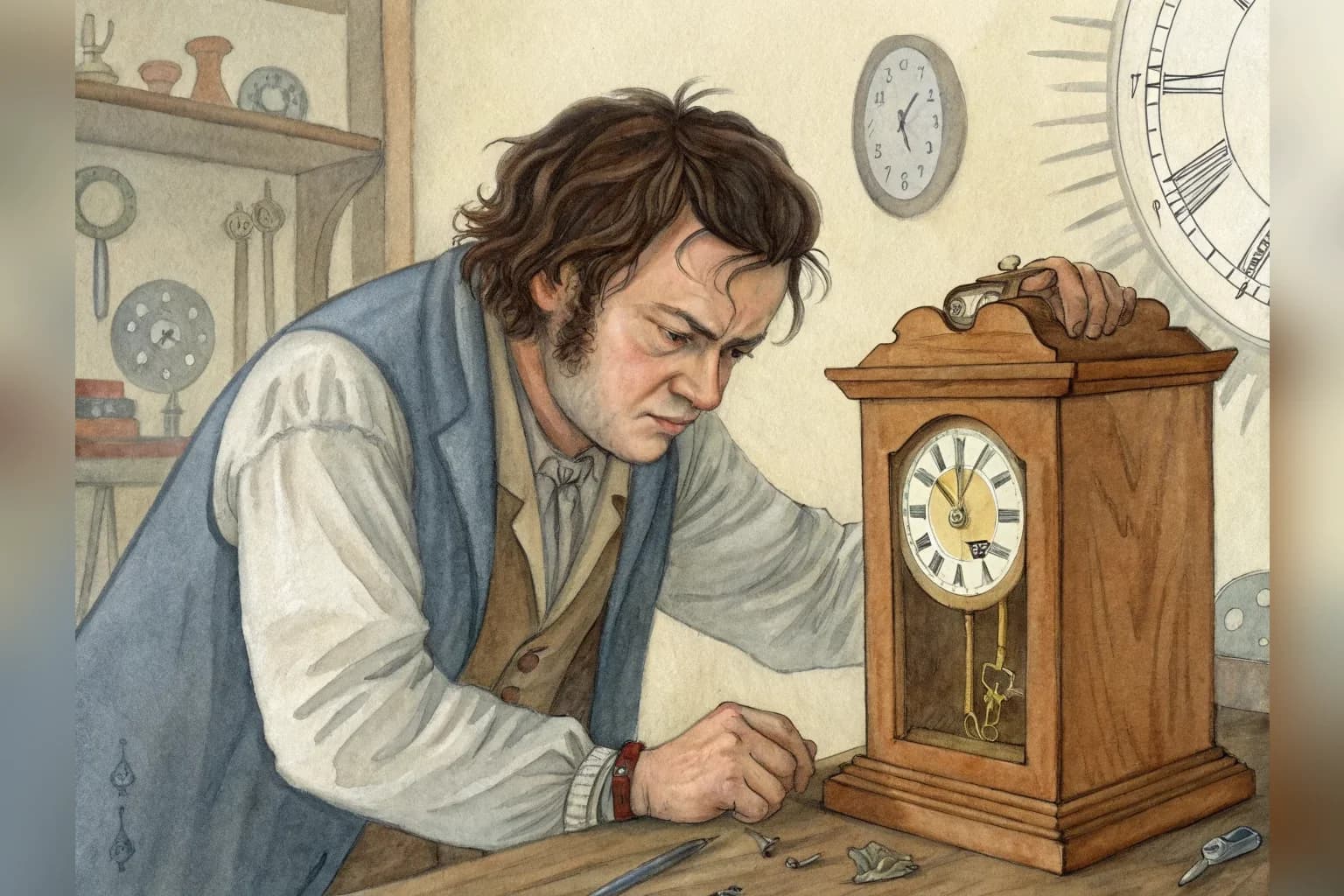
Sergei Ilyich Voronov's workshop occupied a basement unit in the Meridian shopping center — wedged between a mobile phone kiosk and a shop selling orthopedic insoles. Above the door hung a sign reading "Watch Repair / Appraisal," the last letter of the final word handwritten over a painted-out correction. Inside it smelled of machine oil and solvent; three fluorescent tubes hung from the ceiling, giving everything the look of an operating theater.
Mark set the oak case on the counter with some effort — hauling it fifteen blocks had been its own ordeal.
Voronov — around sixty, with a professor's beard and a mechanic's hands — studied the clock the way a doctor studies a patient with puzzling symptoms.
— Where did this come from? — he asked, skipping any greeting.
— A client's. I'm a watchmaker myself, but there's something... out of the ordinary.
— Out of the ordinary, — Voronov repeated, without inflection, and reached for his loupe.
Mark played the recording.
Voronov listened without taking his eyes off the mechanism. Then he asked to hear it again. Then once more.
— That's not a voice, — he said at last.
— What?
— It's resonance. — Voronov tapped the case at three points. — There's a cavity inside. Non-standard. When the pendulum swings at a certain frequency, the air vibrates in a way that produces — he paused — something resembling speech.
Mark stared at the clock.
— So there's no voice at all?
— Physics, — Voronov shrugged. — Nothing mystical about it. If you like, we can open it right now — I'll show you the cavity. But I'll warn you: if something's been hidden in there, that's outside my area. — He paused. — People used to store things in old clocks. Things they didn't want found.
Mark rested his hand on the warm oak side of the case and felt something click faintly inside.
Scene 4 — Development
Mark was already hauling the clock toward the door when Voronov called after him:
— Hey. At least leave a receipt. In case it turns out they're not yours.
Mark stopped. He wrote his name, phone number, and workshop address on a scrap of paper — and walked out without looking back.
Lesnaya Street met him with an October wind and the smell of burning leaves. The oak case pulled at his arm, cutting into his forearm. Passersby glanced over: a man in jeans and a jacket carrying what was clearly an antique clock looked about as natural as a double-bass player queuing for coffee. Mark adjusted his grip and picked up his pace.
Nina Sergeyevna opened the door before he had a chance to ring.
— I heard footsteps, — she explained. — Heavy ones. So I knew you'd brought something.
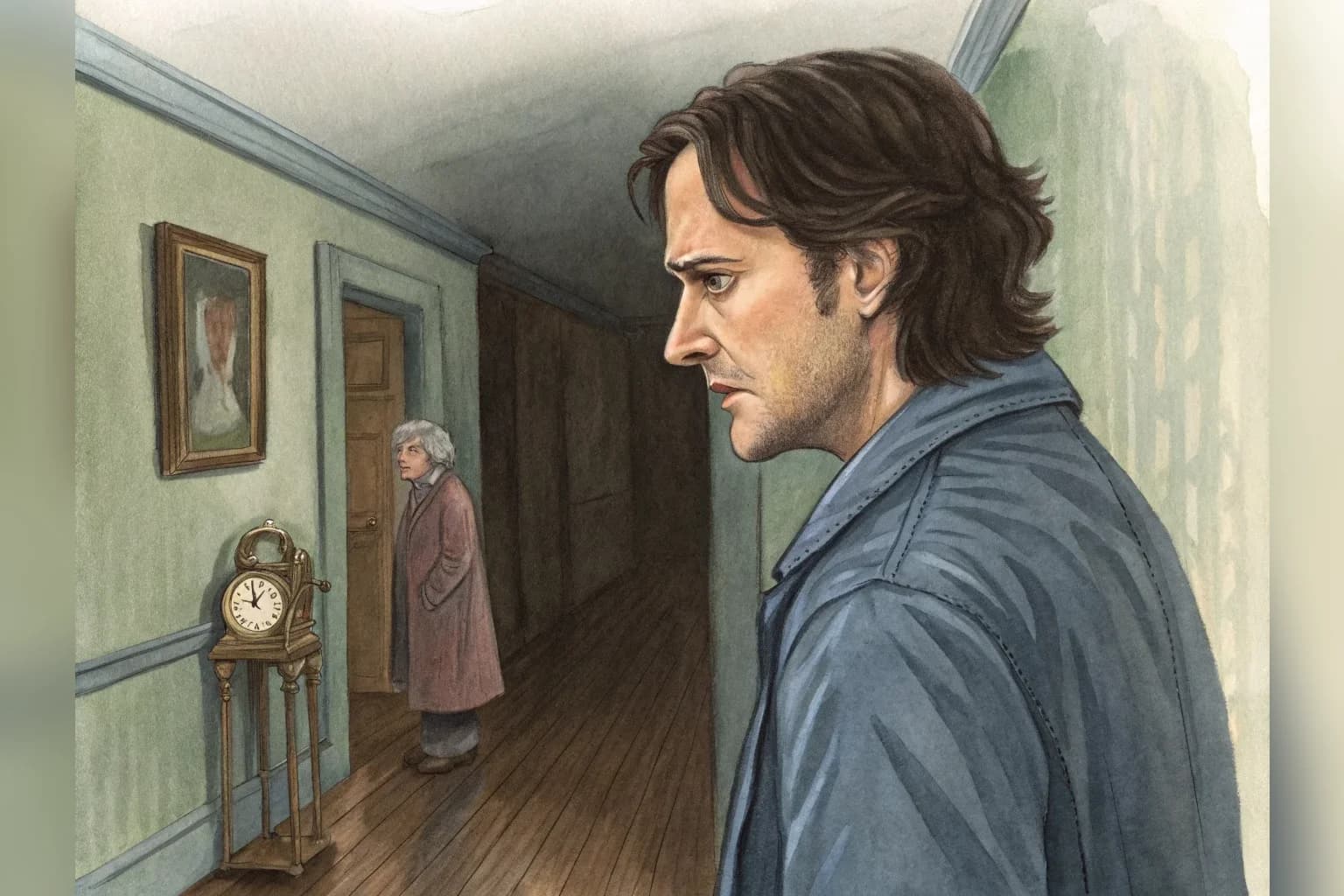
She didn't ask where he'd taken the clock. She simply stepped aside to let him in. The hallway smelled of cinnamon and old paper; photographs in wooden frames lined the wall — a woman in a 1950s dress, a stern gaze, dark hair.
— Is that her? — Mark asked, nodding at the photograph.
— Yes. — Nina Sergeyevna was looking at the clock he'd set down by the door. — Where did you take it?
Mark opened his mouth.
— Never mind, — she stopped him. — Just tell me: is there something inside?
He felt his breath catch. He hadn't told her about the cavity. Not a word.
— How do you know?
The old woman took off her glasses and folded them into her apron pocket.
— Because my mother told me not to go looking inside, — she said quietly. — Right before she died. I thought she was delirious. — A pause. — Apparently not.
The clock stood between them, quiet and warm, almost alive. And Mark understood that he now had to decide: open the case right here, with Nina Sergeyevna present — or first ask her to tell him exactly what her mother had left behind.
Scene 5 — Finale
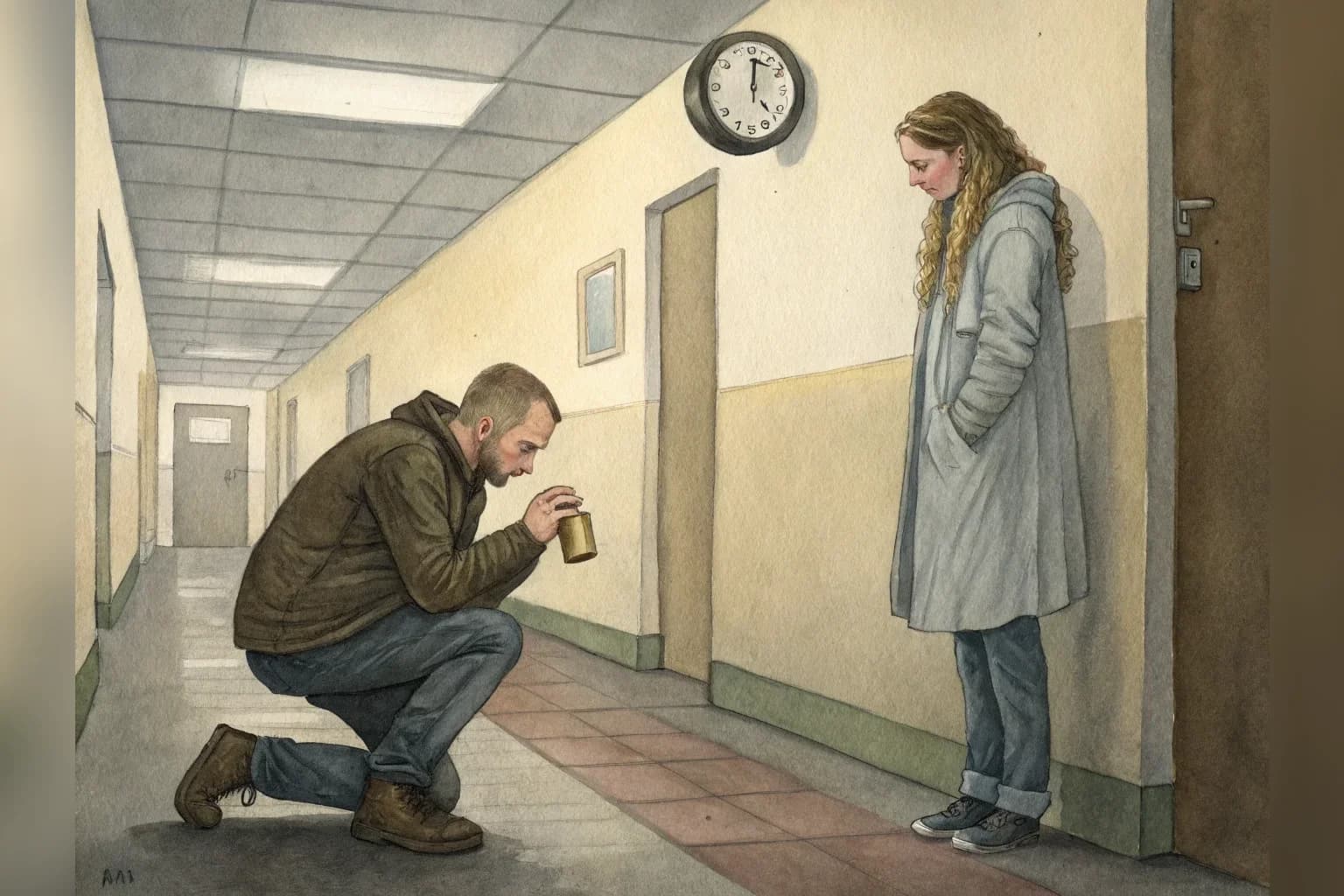
Mark lowered himself to his knees in front of the clock, right there in the hallway.
— Tell me, — he said. — Tell me first.
Nina Sergeyevna was quiet for a moment, then went to the kitchen and came back with two cups of tea. She set one down on the floor in front of Mark — without ceremony, as though men kneeling before clocks were a perfectly ordinary occurrence in her home.
— My mother was an engineer, — she began. — In the fifties she worked at a classified facility. Something to do with resonant frequencies. She never talked about the details. Only once she said: "I found a way to leave a trace. Not in documents — in the air."
Mark looked at the warm oak side of the case.
— She hid it inside, — he said slowly. — Not a voice. A device.
Nina Sergeyevna nodded — the way you nod when you finally hear something you've long known.
They opened the clock together. Beneath the pendulum, in a niche that had clearly been cut by hand, lay a small brass cylinder — the size of a lipstick tube, with fine slots along its sides. When Mark picked it up, his ink-stained fingers felt a faint vibration.
— A resonator, — he said quietly. — Tuned to the pendulum's frequency. While the clock runs, it stays silent. When the clock stops, it accumulates. Forty years.
He carefully removed the cylinder. The clock started immediately — steady, confident, as if it had never stopped at all.
Nina Sergeyevna took the cylinder in both hands and closed her eyes. A single quick line crossed her cheek — not from age, but from something else.
— At last, — she whispered.
Mark put his tweezers away and understood that those two words had never been meant for him.